The Second Sale: How to Turn One-Time Etsy Buyers Into Repeat Customers
By The myShop Team · 2026-08-15 · 13 min read
You spent three weeks getting that listing to rank. You paid for the ad click. You packed the order beautifully, wrote the note, shipped it a day early. The buyer left five stars and said it was perfect. And then they vanished, and on Monday you started the whole thing over with a stranger.
That is the shape of most Etsy shops. Every sale is a first sale. The shop never compounds, because nothing carries over from one month to the next except the listings themselves.
Key takeaway: The second sale costs you almost nothing in fees, ads, and search competition, so a small amount of deliberate follow-up work has a better return than the same hours spent chasing new traffic. Build one repeatable post-purchase sequence and one product ladder, and the rest takes care of itself.
Why the second sale is worth more than the first
The second sale is worth more because you do not pay to acquire it. The first sale required a search ranking, a click, a decision from someone who had never heard of you, and possibly an ad spend. The second one starts with a person who already has your item in their house and already knows the packaging shows up in good condition.
Etsy's marketplace ended 2025 with 86.5 million active buyers, down 3.4% from the year before. Slightly more than half of Etsy's active buyers have been shopping the platform for over three years. These are not casual browsers. They are people who default to Etsy when they need a gift, and they already have a favorites list.
There is a quieter benefit too. Repeat buyers convert at a higher rate on the same listing, and conversion is one of the signals Etsy's search uses to decide whether your listing deserves more impressions. A returning customer who buys immediately does not just give you revenue. They make the listing look better to the algorithm.
What actually makes an Etsy buyer come back?
Buyers come back for practical reasons far more than emotional ones. When Etsy shoppers were asked what would influence them to buy from a seller again, the answers were unglamorous and consistent.
| What buyers said | Share who cited it | What you can do about it |
|---|---|---|
| Free shipping | 64% | Price it in and offer free shipping over $35 |
| Reasonable pricing | 58% | Consistency matters more than being cheapest |
| Fast shipping | 53% | Ship early against your stated window |
| Product quality or variety | 51% | Give them a second thing to buy |
Buyer survey figures reported for Etsy shoppers, as of 2026. Percentages can shift year to year.
Look at that list again. Three of the four are things you set once and forget: your shipping price, your price points, and your processing time. Only the fourth, variety, requires ongoing work, and it is the one most small shops skip.
"If a happy customer opens your shop and finds only the thing they already own, you have not lost them to a competitor. You have lost them to an empty shelf."
Build a product ladder before you build a follow-up
Give a returning buyer something obvious to buy next, or the best follow-up email in the world lands on a dead end. A product ladder is just three or four things at different prices that a person who liked the first item would plausibly want.
The pattern that works is a small add-on, a matching item, and an upgrade. If you sell a personalized necklace, the ladder is an extra charm, a matching bracelet, and a gift set of both in a box. If you sell candles, it is a wax melt sampler, a second scent in the same family, and a three-candle seasonal set. If you sell digital planners, it is a single add-on page pack, a companion habit tracker, and the full annual bundle.
- The add-on: under $15, low friction, an impulse purchase for someone already in your shop. This is what most second orders are.
- The match: similar price to the original, same style, so it reads as "the other one in the pair" rather than a new decision.
- The upgrade: a bundle or set priced 2 to 3 times the original. Fewer buyers take it, but the ones who do lift your average order value noticeably.
- The refill or repeat: only some products have this, and if yours does, it is the strongest rung on the ladder. Anything consumable gets bought again on a schedule.
Put these in the same shop section so they sit together when someone lands on your shop home. If your sections are still a pile of unsorted categories, fix that first, because sections are the path a returning buyer walks.
The post-purchase sequence, step by step
The sequence has four touches and takes about ten minutes per order to set up the first time, then almost no time after that because you reuse the same text. Nothing here requires software you do not already have.
- The confirmation message, sent within a few hours. Etsy already sends a receipt, so yours does something different: it sets an expectation and gives the buyer one reason to remember your shop name. Two sentences. When it ships, and one specific detail about how the item was made.
- The shipped message. Short, no coupon yet, no ask. This is the message that keeps them from opening a "where is my order" case, which protects both your review and your time.
- The thank-you coupon, 24 to 48 hours after delivery. This is the one that matters. The item is in their hands, the feeling is fresh, and there is no risk left in the transaction. A 10 to 15% code with a 30 to 60 day expiry converts better than the same code sent at any other moment.
- The seasonal nudge, roughly 60 to 90 days later. Tied to something real, like a new collection or a holiday your product actually fits. Not a monthly newsletter nobody asked for.
Watch out: Do not ask for a review and offer a coupon in the same message. Etsy's policy does not allow incentivizing reviews, and even the appearance of it puts your account at risk. Send the thank-you coupon on its own, with no mention of feedback.
Etsy's built-in retention tools, and what each one is for
Etsy gives you four retention features at no extra cost, and most sellers use one of them. Here is what each actually does.
- Shop coupons. You create a code, set a percentage or dollar amount, set a minimum order and an expiry, and hand it out however you like. This is the tool behind the thank-you message.
- Targeted offers. Etsy automatically emails buyers who favorited an item or abandoned a cart. You choose the discount level. It runs without you, and it reaches people who never bought at all, which makes it a first-sale tool that happens to live in the same menu.
- Shop followers and favorites. When someone favorites your shop, Etsy occasionally surfaces your new listings to them. It is a soft channel and you cannot message the list directly, but it costs nothing to build. Ask for the follow in your packaging insert, not in a message.
- Sales and discount events. A shop-wide sale with a visible strikethrough price. Good for clearing seasonal stock, bad as a permanent state, because a shop that is always on sale trains buyers to wait.
Outside Etsy, an email list is the only retention asset you actually own. You cannot scrape buyer emails from orders, and you should not try. What you can do is put a card in the box with a QR code to a simple signup page offering something small, a discount or a free printable, and let people opt in on purpose.
What the numbers look like when it works
A repeat rate of 10 to 20% is a normal, healthy range for a small handmade shop that does nothing special. Shops that run a deliberate post-purchase sequence tend to land in the 25 to 35% range within a couple of seasons. The revenue effect is larger than the percentage suggests, because repeat orders skew toward higher-value bundles.
| Repeat rate | Repeat orders | Annual revenue |
|---|---|---|
| 10% | 20 | $6,720 |
| 25% | 50 | $7,800 |
| 35% | 70 | $8,520 |
Based on 200 first orders at $30 each and repeat orders averaging $36. Your numbers will differ; the shape of the curve is the point.
That gap is about $1,800 a year on a shop doing $6,000, and it came from messages you write once. Compare that to what it would cost in ad spend to buy 50 extra first-time orders.
What goes in the box
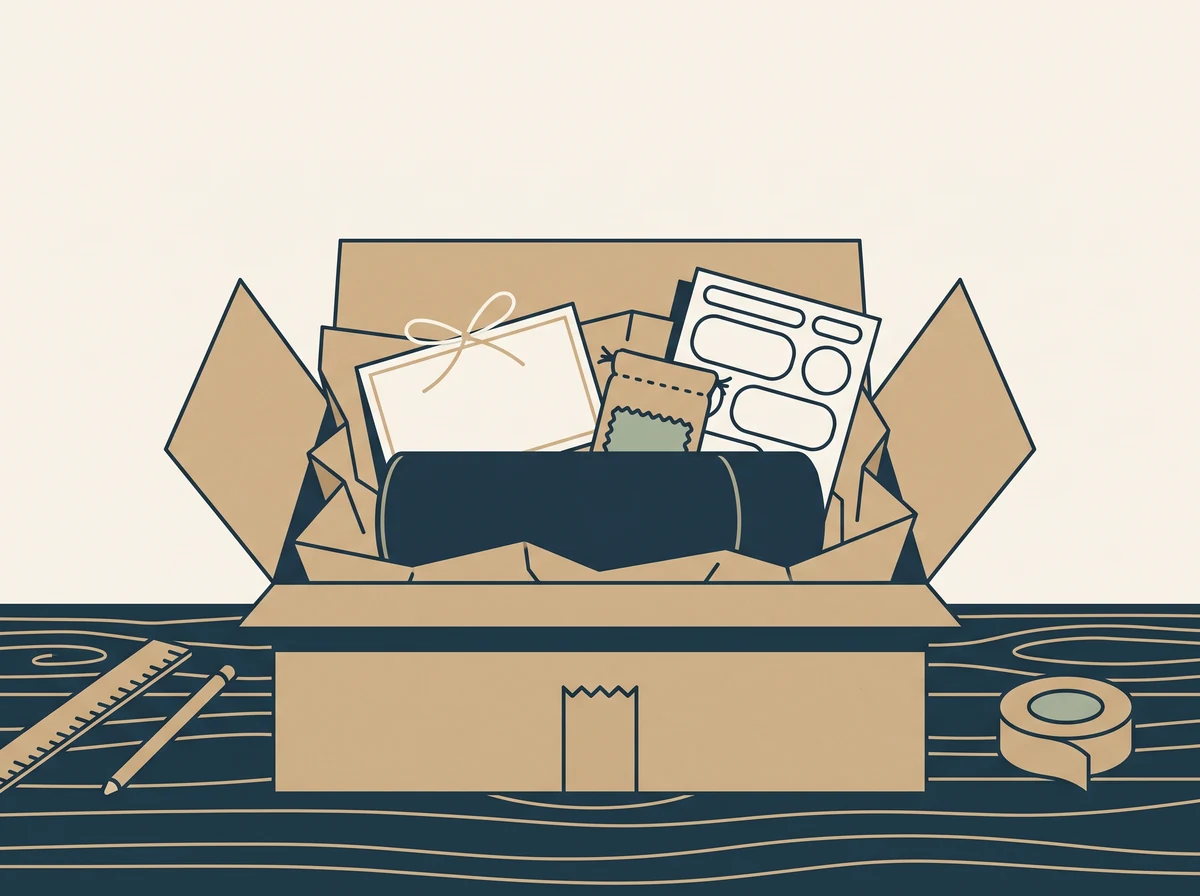
The insert card is the cheapest retention tool you have, and it is the only one the buyer physically holds. A card costs a few cents printed in bulk and it does three jobs at once: it names your shop, it points somewhere, and it gives the buyer a small reason to act.
Keep it to one side of a small card. Shop name and a one-line description of what you make, so the card still means something if it ends up on a fridge. A QR code to whatever you want them to do next, which is usually an email signup with a discount attached, not your Etsy shop, since they can already find that. And a handwritten line, even just a name and a thank you, because it is the part people photograph.
What not to put on it: a request for a review, a list of every social account you own, and a paragraph about your journey. The card has about four seconds of attention. Spend it on one action.
If you sell digital products and there is no box, the equivalent is the file itself. Add a single page at the front of the PDF with your shop name, a link to the rest of your catalog, and the coupon code. People keep files far longer than they keep packaging, and that page gets seen every time they open it.
How to track it without a spreadsheet you will abandon
Track three numbers, once a month. Everything else is noise at this stage.
- Repeat order share. Of your orders this month, how many came from a name or address you have shipped to before. Etsy shows a repeat-buyer indicator on orders, so this is a count, not a calculation.
- Average order value, split by first and repeat. If repeat orders are not larger than first orders, your ladder has no upper rungs.
- Coupon redemption rate. Codes issued versus codes used. Under 5% means the offer, the timing, or the ladder is off. Over 20% is unusually good and worth understanding.
If pulling those numbers by hand is the reason you stop doing it, that is exactly the sort of thing to hand off. You can ask Spryte to look at your order history and tell you which buyers have ordered more than once and what they bought the second time.
Four mistakes that quietly kill the second sale
Most retention problems are not strategy problems. They are small operational things that make a returning buyer's path harder than it needs to be.
- Your shop name is invisible. The buyer remembers the item and not who made it. Put your shop name on the packaging, on the insert card, and in the first line of your messages. Etsy's own emails do not do this job for you.
- Everything in your shop is the same price. A shop where all 40 listings sit at $28 has no ladder. There is no small yes and no bigger yes, only a repeat of the same decision.
- You retired the listing they wanted to reorder. Deleting a sold-out or seasonal listing breaks the link a buyer saved. Set it to inactive instead, or renew it when the season comes back around, so the URL survives.
- The follow-up reads like a form letter. One specific detail about their actual order, the color they chose or the name they had engraved, turns a template into a message. It takes five seconds and it is the difference between being remembered and being filed.
A realistic 30-day plan
You do not need to build all of this at once, and trying to usually means none of it ships. Work in this order.
| Week | Do this |
|---|---|
| 1 | Write the four message templates. Save them in Etsy's saved replies. |
| 2 | Create the thank-you coupon code. Set 15%, 60-day expiry, no minimum. |
| 3 | Add one add-on product under $15 that pairs with your best seller. |
| 4 | Turn on targeted offers for favorites and abandoned carts. Record your baseline repeat rate. |
Come back in 90 days and compare. That is long enough for a first cohort to cycle through and short enough that you will still remember what you changed.
Frequently asked questions
How do I get repeat customers on Etsy?
Give buyers a reason and a path to return. The reason is usually a thank-you coupon sent 24 to 48 hours after delivery, and the path is a product ladder of two or three related items at different prices. Etsy buyers cite free shipping, reasonable pricing, fast shipping, and product variety as the main things that bring them back, so those four settings matter more than any clever marketing.
Can I email my Etsy customers directly?
No. Etsy does not give you buyer email addresses for marketing, and using order contact details for promotional email violates Etsy's policies. You can message buyers inside Etsy about their specific order, and you can invite them to join your own email list voluntarily, usually with a card in the package linking to a signup page.
What is a good repeat purchase rate for an Etsy shop?
Roughly 10 to 20% of orders coming from returning buyers is typical for a small handmade shop with no deliberate retention work. Shops that run a consistent post-purchase sequence and offer complementary products often reach 25 to 35% within two or three seasons. Consumable and refillable products sit higher than one-time keepsakes.
Should I offer a coupon for a review?
No. Etsy prohibits incentivizing reviews, and offering anything of value in exchange for feedback can put your shop at risk. Send your thank-you coupon as its own message with no reference to reviews, and let good reviews come from the order experience itself.
When is the best time to send a follow-up coupon?
Send it 24 to 48 hours after Etsy marks the order delivered. The buyer has the item, the experience is fresh, and there is no outstanding risk in the transaction. Sending at purchase is too early, because the sale is not yet proven, and sending a month later means competing with everything else in their inbox.
Related reading
To set up the discount side properly, read A Simple Pricing Formula for Etsy Sellers, and for the automated version of the nudge described above, see Etsy Interested-Shopper Offers.